Engineering Philosophy
The Sheet You Approve Once
A build with no natural ceiling became something we could put a price on, and the thing that changed was not the generating. It was agreeing what the answer looks like before any of it runs.

Wilfred Greyling
Systems & Infrastructure
TL;DR
We had a tier on a price list that nobody pushed, because the work behind it had no natural ceiling. What made it sellable was not that generating images got good. It was that a client could approve one reference and everything after it had to match. When output gets cheap, the scarce thing becomes agreement, and a locked reference is what agreement looks like when you write it down.
Why do some things stay on a price list unsold?
The portfolio platform we built for advocates has three tiers. The first two are curated templates. The third is built from nothing, for one person, and for a long time it sat on the price list without anybody really selling it.
Not because there was no demand. Because a design made from scratch for one person is work with no obvious edge to it, and there was no honest way to take several of those at once. You can price a template. Pricing an unbounded amount of judgement is how firms end up doing three months of work for a one-month fee and calling it a learning experience.
The part that had no ceiling was not the code. It was the pictures.
What actually stops a build made for one person being sellable?
A portfolio that is genuinely somebody's needs them in it. Not one headshot repeated at four sizes. Them at a desk, them in a corridor, them in the settings the pages move through, in a way that holds together as one person rather than four separate afternoons.
Which means asking a working advocate to give up a day to a photographer, in six locations, for a website. Nobody at the Bar has that day. Asking for it is how a good idea quietly stops, not with a refusal but with a diary that never opens up.
So the tier existed and the thing that would have made it worth buying was the thing that made it impossible to deliver.
What made it feasible?
Generating a picture of a person got good a while back. That on its own did not help, and it is worth being precise about why: a good picture of roughly the right person is useless when you need eleven of them and they all have to be the same person.
What changed is that generating against a locked likeness became reliable enough to build on. The advocate sends one or two photographs. Those become a character sheet, which is a single reference showing who this person is from several angles, in the wardrobe the portfolio will use. They look at it. They approve it, or they say what is wrong and it gets remade.
Then every image and every piece of motion in that portfolio is made from that sheet.
The approval is the invention. Not the generating, which anybody can do. The moment where a person looks at one artefact and says yes, that is me, is what turns an open-ended amount of production into a bounded amount, because from that point forward there is a right answer to compare against and disagreements are about matching rather than about taste.
Where did the technique come from?
The uncomfortable and slightly funny part is that this was not a technique we worked out for a client. It is how we make our own pictures.
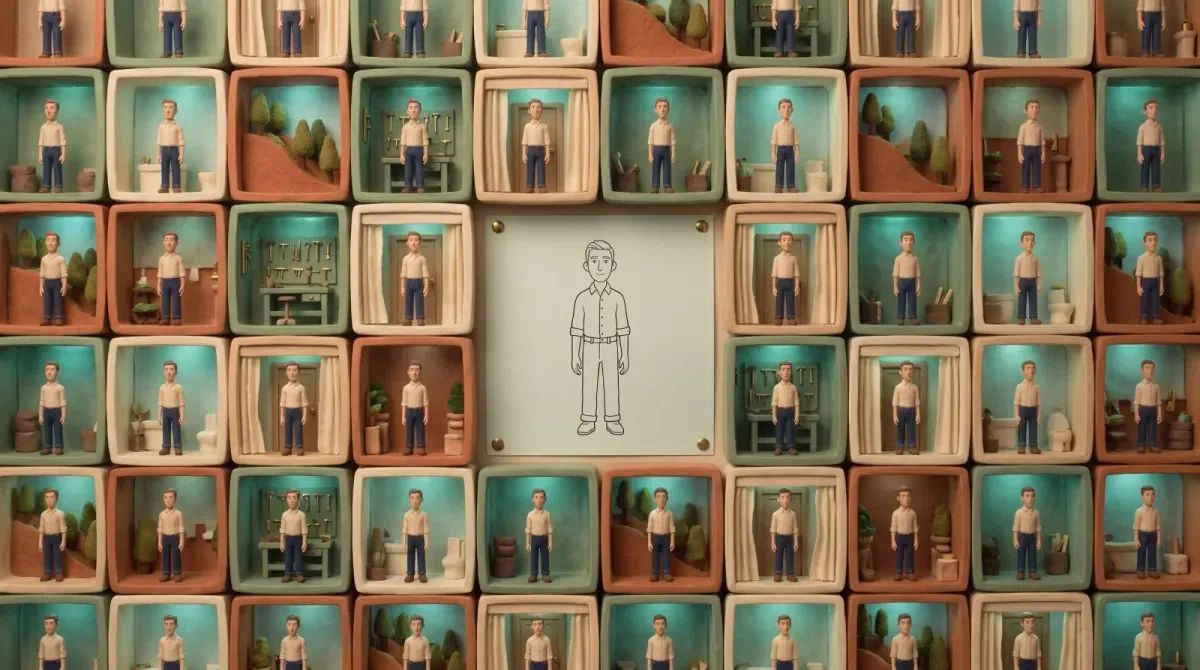
The claymation world this site runs on is held together by exactly the same discipline. There is a locked library of reference sheets, one for each character and each set. There is a style preamble that goes at the top of every prompt, unchanged, never paraphrased. Every render is fired with the relevant sheets attached, and anything that comes back not matching them is wrong by definition rather than by opinion.
We built that because without it the world drifts. Skin tone moves. A machine changes shape between two shots. A building is three floors in one picture and four in the next, and nobody notices until all of it is on a page together and the whole thing looks slightly dreamed.
So our own production constraint turned out to be a client's feasibility answer. I did not see that coming, and I have started watching for the pattern: the thing you had to invent to survive your own process is often the thing somebody else is stuck on.
How does a locked reference go wrong?
A locked reference has a specific way of going wrong, and it is worse than having no reference at all, because it fails quietly and it fails with confidence.
Ours sat marked as locked for five weeks while the finished film moved on without them. Every render fired in that period came back correct against the sheet and wrong against the thing people would actually see. Nothing went red. The renders were good. They were answers to a question that had stopped being the question.
What that cost us was a run of work that all had to go again, and what it taught us is that locking a reference is not the end of the job. Something has to be able to notice when the world has moved past it, and the rule we settled on is blunt: when the sheet and the shipped thing disagree, the shipped thing wins and the sheet is stale until proven otherwise.
Applied to a client's portfolio, that is the difference between a character sheet being a decision and a character sheet being a fossil.
Where I think this goes
The general version, stated more confidently than I can prove: as the cost of producing an artefact falls, the cost of agreeing what a good one looks like does not fall with it. It becomes the whole job.
Which suggests a fair amount of work over the next few years is going to be about building the approval gate rather than the generator. Deciding what the reference is, who signs it, what happens when reality moves past it, and how you tell a thing that matches from a thing that is merely plausible.
None of that is glamorous, and none of it is what gets demonstrated on stage. It is the part that decides whether any of it can be sold.
More from the workshop: The Stack Has Changed. Has Your Thinking?