Case Study
We had to run it ourselves first
There are companies that sell software they do not use. We never worked out how that is allowed, so ReadyRun runs on the software it sells, including the parts a customer touches.

Wilfred Greyling
Systems & Infrastructure
TL;DR
ReadyRun tells businesses to buy the ordinary things and own the thing they are best at. We were running on WhatsApp groups, spreadsheets and a free tier, which made that a slogan rather than a position. So the ordinary half went to Mattermost, Plane and Twenty on infrastructure we own, and the half that is actually ours is being built: the website you are reading, becoming the place a customer deals with us for everything they buy. Not because it is cheaper. Because we could not find a platform that would let a business be itself.
The Starting Point
We build business systems for other companies. Internally we were improvising in exactly the way the businesses we serve do: a sprawl of WhatsApp groups where messages were routinely missed, spreadsheets standing in for project tracking, ClickUp until we ran into the limits of the free tier, and a CRM that was really just another group chat with almost no view of the pipeline.
The gap was concrete rather than theoretical. A message about a deliverable would land in one of a dozen chats and disappear. A customer wanting to know where their project stood had to ask, and then wait. A deal’s history lived in scroll-back, if it lived anywhere at all.
There is a version of this that is only embarrassing, and a version that matters. The one that matters is this: what we tell every client is that they should buy the ordinary things and own the thing they are best at. Saying that from inside somebody else’s free tier is not a position. It is a slogan, and we would not have believed us either.
There are companies that sell a thing to customers and do not use it themselves. We have worked at some. We still cannot work out how that is allowed.
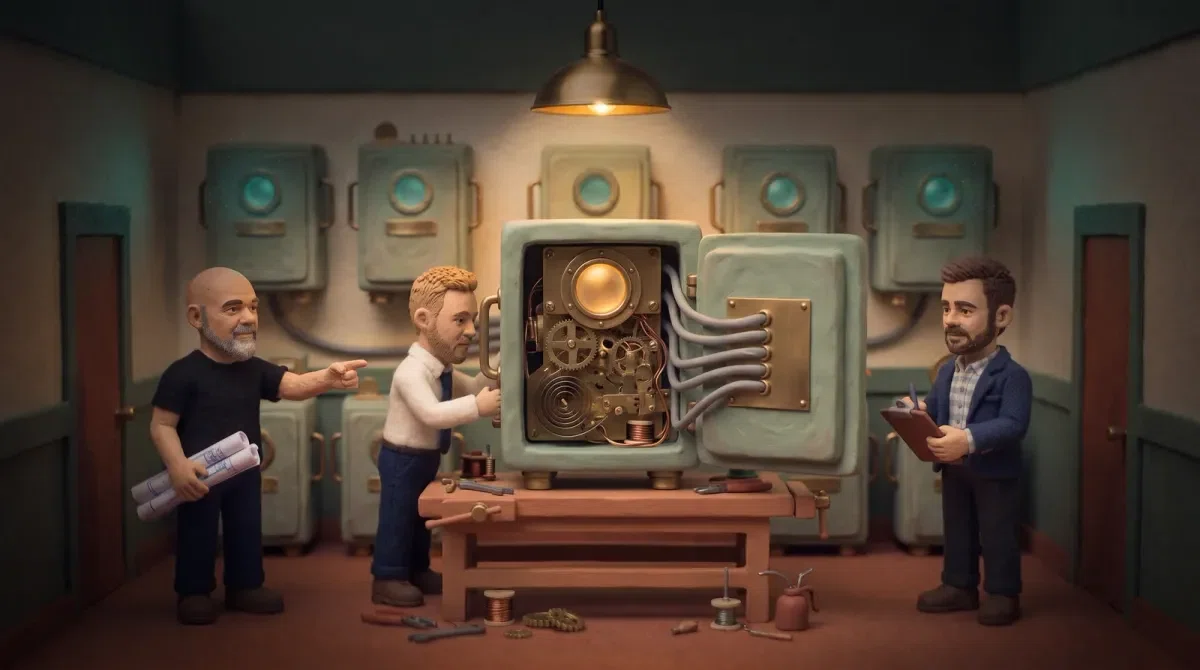
The ordinary half, bought
Talking to each other, tracking work and remembering who we are talking to are not things ReadyRun is going to be better at than the people who do it full time. So none of them got built.
Kept standard
- Mattermost, for talking. One channel per client, project or topic, with searchable history behind it. A message lands where the work is discussed and it stays findable.
- Plane, for the work. Every project, task and status in one place, so a question about where something stands has an answer that does not depend on who is asked.
- Twenty, for the pipeline. Notes that live on the deal they belong to rather than vanishing into a group chat, and a pipeline anyone can look at.
- Infrastructure we run. All of it on servers we provision and manage, so our data, our uptime and our limits sit with us. Openinary serves the images, Documenso handles signing, Brevo delivers the mail.
One thing worth saying plainly, because the cheap reading of this is available and it is wrong. Mattermost, Plane and Twenty are not budget substitutes for real products. They are real products, and in daily use they are a match for the paid tools we left behind. What being open source changes is not their quality. It is who is allowed to use them, and what happens to you when your circumstances change.
The half that has to be ours
The other half of the same sentence is the one that costs something. What a business is best at is the part nobody sells, and for ReadyRun that is the engine underneath this website: the capacity model, the estimating, the way an offer turns into a working system on somebody’s infrastructure.
The site you are reading is the front of it. It is becoming the place a customer deals with us for everything they buy from us, across GoFast and GoFar alike, reading from the same projects, the same pipeline and the same channels the team works in. A good deal of what it will do is still under wraps and some of it is not live yet, which is the honest state of a thing being built while it is being used.
That is the whole of the position: standard software for the ordinary things, owned software for what you are best at. It is not a preference about tooling. It is a claim about where a business should spend the money it has to spend.
A login is not an experience
Once the software is yours, letting a customer see their own work costs nothing, and the first thing we did was exactly that: hand them an account on our own Plane, scoped so they see their projects moving and can raise a request against the work itself. That is the Starter Pack answer, it works, and it is a genuine improvement on being told to wait for a status email.
It is also not the finished thought. Three good products are still three products, and a customer who has bought one thing from you should not have to hold three sets of credentials to see how it is going. Being issued logins is what dealing with a supplier feels like. It is not what buying something should feel like.
So the progress comes back through our own screens instead. Same projects, same channels, same pipeline underneath, presented once, in one place, with our name on it. The tools do the work they are good at and stay out of the customer’s way.
What a client gets out of us running it
None of this was done to spend less. It was done because we went looking for a platform that would let a business be shaped like itself, and did not find one.
- Room to be shaped like your business. Most platforms give you a set of shapes and a settings screen, and the work of the next year is bending the company towards one of them. Owning the software means the bending goes the other way.
- Your customers are not a line item. Per-seat pricing quietly decides who is allowed to see the work, and the first people cut are the ones outside the company. When a seat costs nothing, that decision gets made on whether it helps rather than on what it costs.
- It does not have to feel like enterprise software. The clunkiness most people accept as the price of a serious system is not a law of nature. It is what happens when nobody owns the surface a customer actually touches.
- We have already made the mistakes. Every rough edge in this toolkit was found by running our own delivery through it, not by piloting. What a client gets is the version after that.
Where it stands, and what it is not yet
The bought half has been carrying real delivery work for months, and the business runs on it every day. Money moves through software we own: an order, an invoice and its delivery are ours end to end.
The layer that puts all of it behind one screen for a customer is being built and is not finished. Today a client who wants to watch their project does it in Plane, with an account we issue. That is the honest state of it, and this page will be wrong about the detail again soon, because the thing it describes is still moving.
Which is the last reason for owning it. Software you rent changes when the vendor decides. Ours changes on Tuesday because somebody on the team logged the rough edge on Monday.
Recognise the situation?
Most growing businesses have a version of this story: WhatsApp groups doing the work of systems, a spreadsheet standing in for project tracking, and a pipeline that lives in somebody’s head. We lived it and closed the gaps, on software where inviting your whole team, and your customers, does not cost another seat. If it sounds familiar, we would like to hear from you.