Case Study
Three tiers, one place to change anything
A portfolio at the top tier looks nothing like one at the bottom. Behind all three, the same admin panel holds the same facts, so an advocate can move up without typing anything twice.

Marnus van Staden
Product & Process
TL;DR
Humanicate wanted to give advocates a proper presence online, and commissioning a website per practitioner was never going to work. Folio is a portfolio platform with three tiers, from a curated template up to one built from scratch for a single advocate, where every tier reads its content from the same admin panel. The platform and the infrastructure were built without being charged for. ReadyRun is paid a share of what Humanicate charges an advocate, per portfolio produced and per month, so the income starts when a sale does. One portfolio is live and two more are with their advocates for sign-off.
The Starting Point
Humanicate works where law meets professional identity. Marion-Rose Banks, Humanicate’s managing director, had noticed something the profession had largely stopped noticing about itself: in a job where reputation is the currency, most advocates were either invisible online or represented by a paragraph in a chambers directory.
The gap was specific. An advocate building a practice wants their standing on the page: practice areas, court admissions, published thinking, the pro bono and community work. A website builder knows nothing about a legal career, and a junior at the Bar and a senior silk need genuinely different things. Commissioning one site at a time answers it for one person and for nobody else.
And it is a profession with rules about this. The Legal Practice Act, the LPC Code of Conduct and the Bar’s code of ethics all set out how an advocate may present themselves, which is why so many of them present nothing at all. Humanicate’s position, and the reason the work is theirs rather than a designer’s, is that the aim is not to find clever ways around those rules but to find out how much is possible inside them.
What Marion wanted was to roll this out across a profession, and the part of that which is hard is not the software. When an advocate signs up, Marion goes and finds the material, works out what the practice actually is, writes the profile and the insight articles, and takes it back for sign-off. That is the work Humanicate sells, and every hour of it happens before a single page is built.
So the arrangement was shaped around it. The platform and the infrastructure were built without being charged for, and ReadyRun is paid out of what Humanicate charges an advocate: a share of the setup fee for each portfolio produced, and a share of the monthly fee after it. Humanicate did not have to fund a platform before it had proved anyone wanted one, and the production work is paid for by the sale that caused it. How that kind of arrangement is scoped is on the pricing page.
Three tiers, one place to change anything
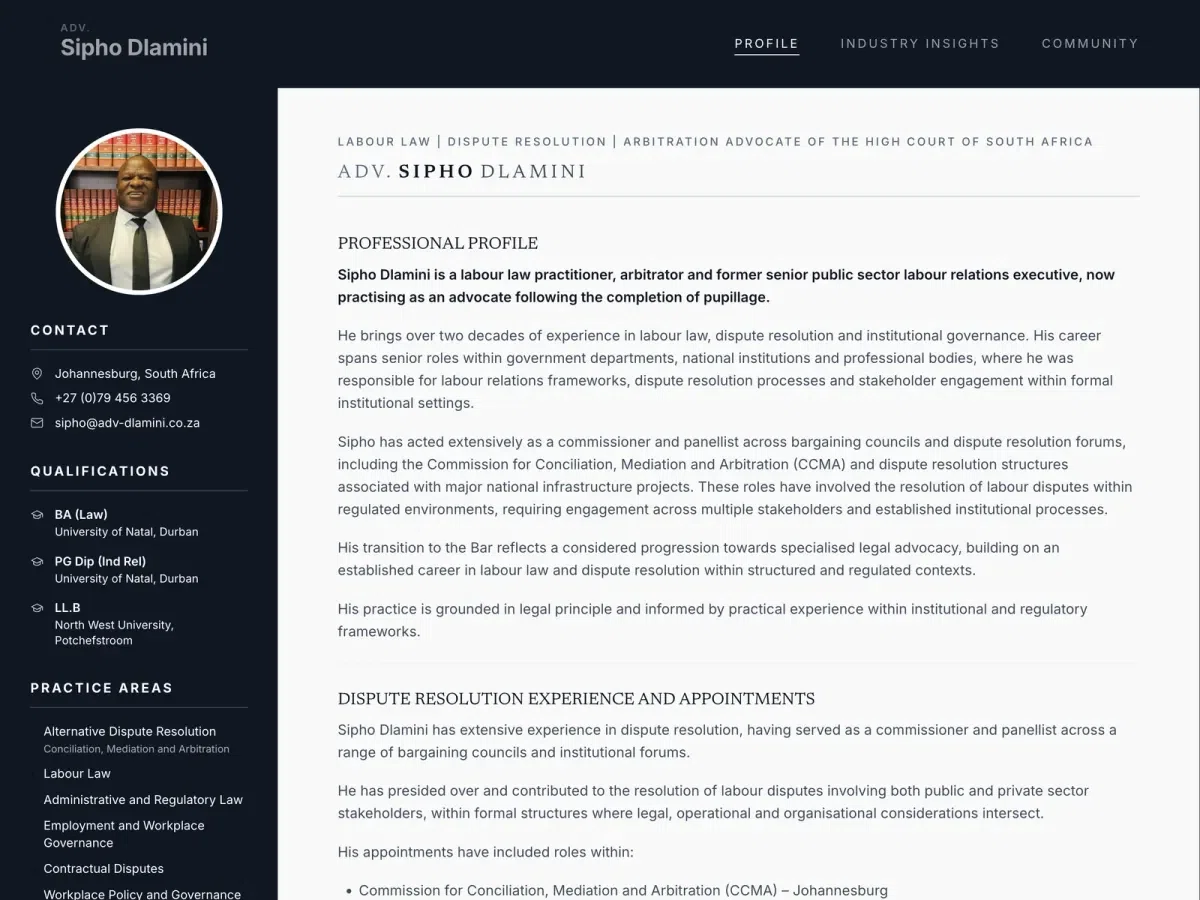
A career at the Bar is not one shape, so Folio is not one product. There are three tiers, and what separates them is how far the design travels from the template.
What differs between the tiers
- Tier 1 and Tier 2. Templates: three at Tier 1 and four at Tier 2, with more added as they are wanted. Each template then offers around five presets, and a preset is a curated set of fonts, colours, spacing and corner radius rather than a colour picker and good luck. Tier 2 also adds published insight articles and the community and pro bono work, which is what turns a page into something worth visiting twice.
- Tier 3. No template at all, and it does not become one afterwards. The portfolio is designed and built for that advocate, and the two currently in sign-off look nothing like each other or like anything at the tiers below.
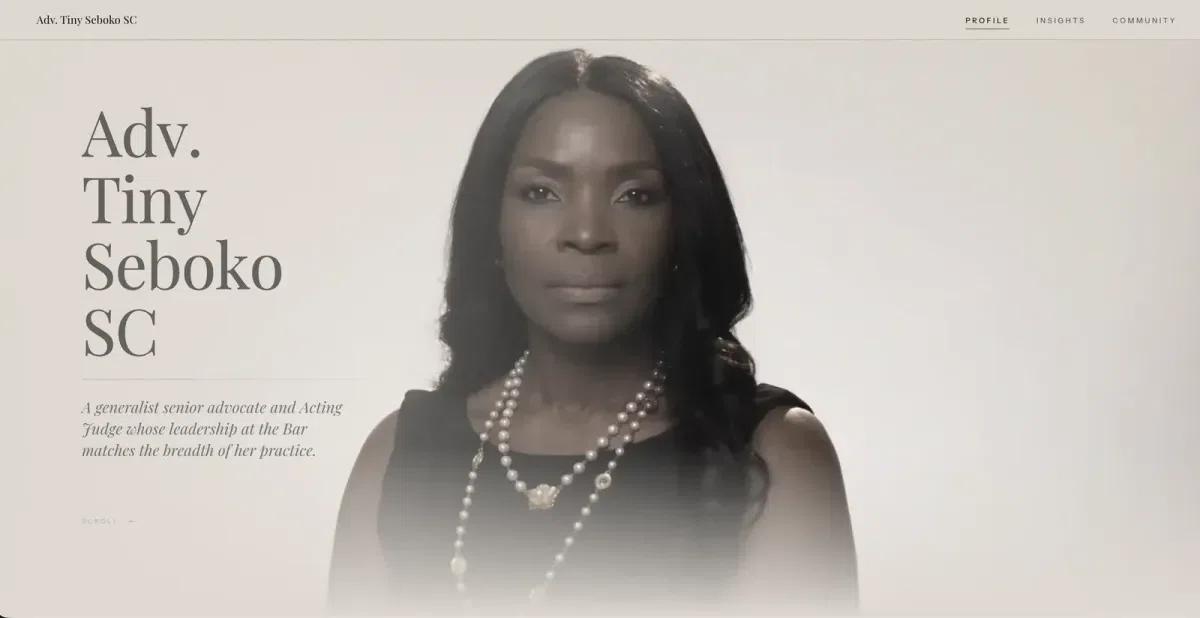
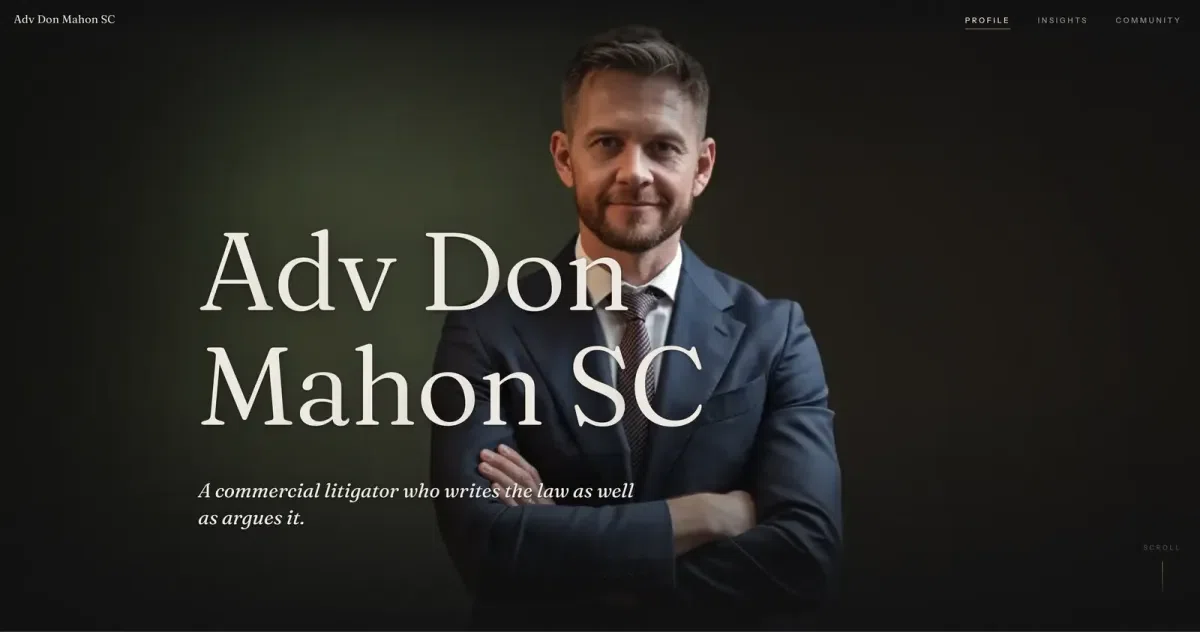
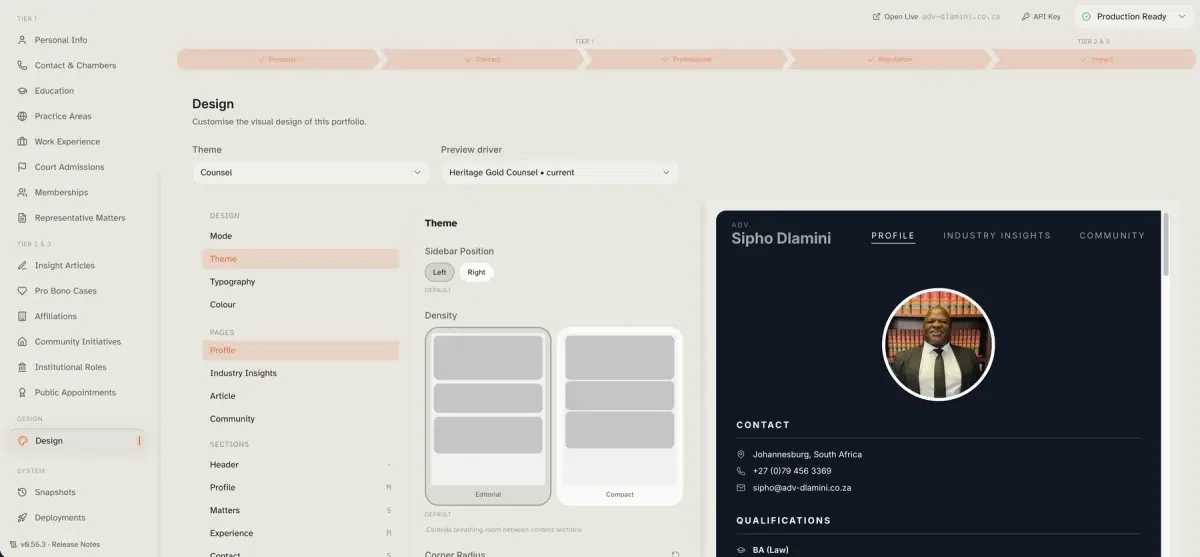
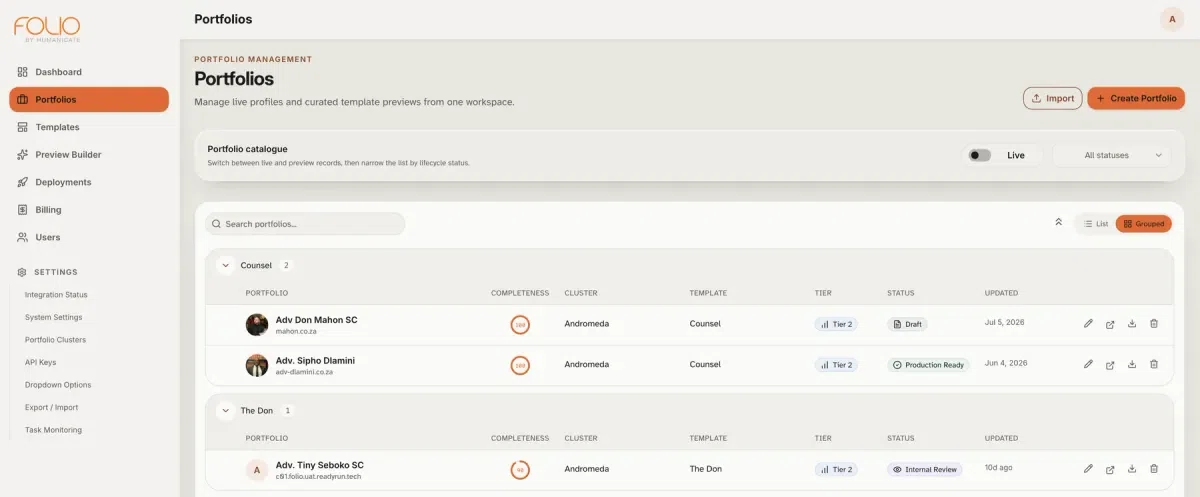
What does not differ is where the content lives. Every portfolio, at every tier, reads its data from one Django API, and that data is captured and maintained in the Folio admin: the practice areas, the court admissions, the articles, and the design settings for whichever template is in play. A Tier 3 build is freeform in its design and still pulls from the same place.
Two things follow from that, and they are the reason it was built this way. Marion changes something once and it is changed. And an advocate who moves up a tier is not asked to supply their career a second time, because none of what they already gave was ever attached to the design.
It runs downward as well, which is the part that actually proves it. A Tier 3 portfolio can be dropped back to Tier 2 and rendered through one of the templates, and nothing is lost on the way, because there was never a second copy of the career living inside the design. Going up is the direction anyone would design for. Going down without damage is the one that tells you the separation is real.
Why Tier 3 is on the menu at all
For a long time it was not. A portfolio built from nothing for one advocate is work with no natural ceiling, and taking on several at once was not something we could see a way through. So the tier existed and nobody pushed it.
What changed is that generating imagery against a locked likeness became reliable enough to build a practice on. An advocate sends one or two photographs. Those become a character sheet, which they approve. Every image and every piece of motion on the portfolio is then made from that approved sheet.
The half of that which matters is the advocate’s. Nobody at the Bar has an afternoon to spend being photographed in six settings, and asking for one is how a good idea quietly dies. Two photographs and a sheet to approve is a different request entirely.
The first portfolio built this way belongs to one of the two advocates now in sign-off. A design made along the way should not be confused with it: pushed towards Tier 3, it kept coming out looking like a template, which is what templates look like. Rather than sell it as something it was not, it went the other way, down into Tier 2 as one of the four an advocate can choose. What that advocate has is not the template; it is the one-off the tier promises.
Tier 3 does not become a template afterwards, and it is not built so that it could. Those portfolios carry scroll-driven behaviour, their own opening and closing frames, and layout with far more moving parts than could sit behind a settings panel and still be usable by anyone. Exposing all of it as configuration would produce a great many levers and nobody able to pull one safely, which is the failure this whole platform is arranged to avoid. A Tier 3 portfolio stays that advocate’s.
Why one portfolio cannot take down the rest
The tiered portfolios are served by renderers deployed in clusters, each one holding up to twenty portfolios and talking to the central API with a key issued for each portfolio it serves. The key is what stops portfolio data being pulled out of the system by a request that has no business asking.
The API and the renderers scale apart on purpose. The admin and API carry the real load and sit on their own machine that can be made as large as it needs to be. A renderer serves pages and can live somewhere small, and more of them can be added without touching the API at all.
The twenty is not an architectural number. Deploying a cluster means updating a domain field, and for a short window during that deploy the portfolios in that cluster are down. Twenty is the size of the group we are prepared to have offline for that window. It is a limit chosen to bound the damage rather than a limit nobody noticed.
“I'm on the brink of rollout out web profiles for advocates at scale, and the team proactively built a system to accommodate that effectively and seamlessly.”
Marion-Rose Banks
Managing Director, Humanicate
What happens when an advocate signs up
A sale sets off a sequence that nobody has to remember to start. A project and its work items are created in Plane inside Humanicate’s own infrastructure. The people whose turn it is are told in Mattermost. The advocate gets a page of their own where they can see where their portfolio has got to, and as each task is completed that page moves on and the next person is called.
The accounting stands across two sets of books at the same time. ReadyRun invoices Humanicate for its share, and Humanicate bills the advocate for the setup and the monthly fee, each inside its own accounting system.
Readers of the Medeq study will recognise all of this, because it is the same pattern. That is the point of it. It gets assembled from parts that already work, so a business that has never run anything technical ends up with the operations of one that has.
What was bought, what was rented, what was built
Kept standard
- Twenty, Plane and Mattermost. The pipeline, the work tracking and the internal messaging. All open source, all running on Humanicate’s own infrastructure as GoFast services rather than rented per seat.
- Openinary, for the imagery. Every portrait and every article image on every portfolio is stored and served through it.
Rented, because running it would be worse
- Brevo, for transactional email. Deliverability is somebody’s full-time problem and it should stay theirs.
Built, because it did not exist
- The Folio admin and its API. Where a portfolio is captured and maintained, and where every design setting for every template is held. This is the part that carries the load and the part everything else reads from.
- The templates and the renderer. Each template with its own configuration, and the clustered renderer that serves them.
- Each Tier 3 portfolio. Designed and built for one advocate, and still reading from the same API as everything else.
Open source where it makes sense, a subscription where one is genuinely better than anything worth running, and a build only for the part that is the business’s own. Here that last part is most of Folio, because a portfolio platform that understands a legal career is not something anyone was selling.
The handover nobody noticed
Folio was started by Armand, one of ReadyRun’s founders, who left for reasons that had nothing to do with the work. The API design and the clustered renderer pattern are his. He handed it over in the early days and it carried on, and the same thing happened on Medeq for the same reason.
Handing a project between developers is normally slow, which is why teams avoid it and why a project quietly becomes one person’s. Here it was close to invisible, because the context and the documentation live in the project rather than in somebody’s head.
That matters for a reason beyond how we staff things. It is the same claim we make about a client owning what runs their business, and this is the version of it that can be checked: if Humanicate ever wanted to take the codebase to somebody else, the thing that makes that possible is not a contract clause. It is that the work was written to be picked up.
Where it stands
- One portfolio live, two with their advocates. A Tier 2 portfolio is live on the advocate’s own domain. Two Tier 3 builds are finished and waiting on sign-off before they move to theirs.
- The next one costs a fraction of a website. Humanicate can take on an advocate without commissioning anything, and the cost of doing so arrives with the sale rather than ahead of it.
- No technical function on their side. Hosting, deployments, DNS and the servers are ours. Marion’s team spends its time on advocates, which is the part of this that only they can do.
“An excellent team who knows their stuff, conceptualise solutions proactively, and is an absolute pleasure to work with.”
Marion-Rose Banks
Managing Director, Humanicate
Recognise the situation?
Plenty of professional firms have a version of this: people whose expertise is far ahead of how visible they are, and no affordable way to close that gap one person at a time. If that sounds familiar, we would like to hear from you.