AI & Automation
The Angler and the Trawler: The Great AI Divide
Most AI conversations only show one kind of fishing. Here's the other one.
Wilfred Greyling
Systems & Infrastructure
TL;DR
There are two kinds of AI at work in any business: the fly-fisherman on a laptop landing rare fish by hand, and the trawler running overnight to bring in the tonnage. Social media only ever shows the first. Most company "AI strategies" are really one power user with a good rod, and the real work is building the dockside between the two.
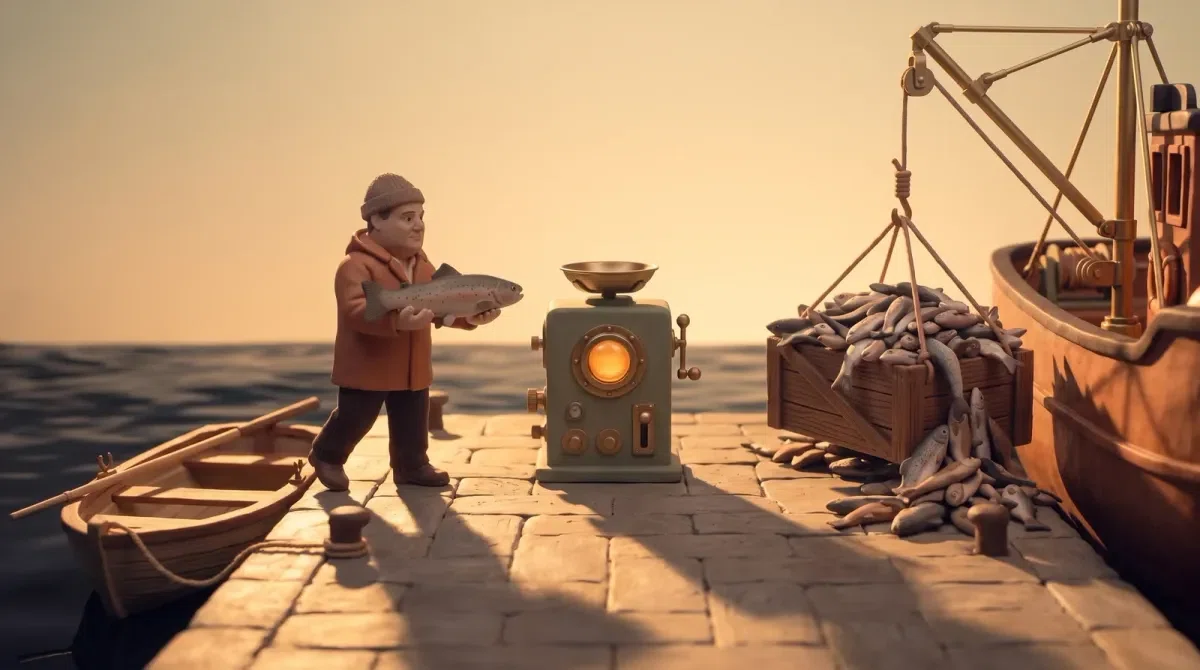
Before the sun was fully up, two boats went out.
One was a hand-built wooden skiff with a single angler in it. A hand-tied fly on a ten-foot rod. A morning of quiet ahead. They cast, read the water, cast again. By noon there were two sea trout in the creel. The morning had been perfect.
The other was a commercial trawler with a crew of six. By the time the angler was cleaning the creel, the trawler's nets had already hauled in three tonnes of hake. They would do it again the next day. And the day after that.
Both came home with fish. They were not doing the same work, and they could not have done each other's.
One coast, two fisheries
Most conversations about AI at work are, if you listen carefully, conversations about only one kind of fishing.
Scroll any feed this week. The AI posts are almost all the same shape: a person at a laptop, a clever prompt, a polished output, an "I built this in an afternoon" story. That is the skiff. It is everywhere on social media because it is easy to show. One person, one rod, one fish. A screenshot and a caption do the whole job.
The trawler has no such story to tell. That is what it is built to be.
A well-run Business AI does not post. It runs overnight. It updates records, clears exceptions, closes out the month, and goes back to sleep. There is nothing to screenshot. A dashboard that does the work of a dozen people is not a post that travels. No creator is building a following off it.
So social media has given us one fishing story, on repeat: one angler, one river, one fish. Most of the people watching are trying to feed a town. Nobody is showing them the fleet.
A fly-fisherman and a trawler
Name them, so we can talk about them clearly. One works a cove by feel, the other works open sea by system. They are not the same kind of fishing, and treating them as if they were is how most AI conversations run aground.
The Laptop AI is a fly-fisherman. It reads the water. It tries a fly, watches what happens, adjusts. It runs on one of the biggest general models because every morning is a little different: a half-formed thought, an odd document, a new kind of question. It can land the fish nobody else could reach, the one tucked in the shadow behind a particular rock. The same stretch of water fished twice in a week will give two different days, and that is often fine, because a human is there, making the call about what counts as a good catch.
The Business AI is a trawler. It runs a route it has fished before, with gear made for the kind of water it is working. It does not read the water. It does not have to. Its job is not to find the extraordinary trout in the shadow. It is to bring in the tonnage, on schedule, at a cost that makes the next trip viable.
A fly-fisherman is useful. So is a trawler. They do not do the same work. The fly-fisherman can spend a morning landing a single remarkable fish. The trawler feeds a town.
What does AI actually cost per task?
Here is the awkward maths, and the reason there is no rate card in it.
An earlier version of this piece quoted what two named models cost per million tokens. Those figures were accurate for about a month. Prices move faster than an article gets edited, and a stale number stated confidently is worse than no number, so what follows is the shape rather than the arithmetic.
The biggest models cost several times what a lighter one costs for the same work. That gap is real, and it is the smaller of the two levers.
The bigger one is what sits around the model. On a laptop, you feed it whatever mess the day gives you: a rambling prompt, half a document, yesterday's chat history for context. You pay for all of it. In a business system the context is surgical. The prompt is templated, the input tight, the output shaped. A lighter model with a scoped context does the same kind of job on a small fraction of what the open-ended version consumes.
Pull both levers and the cost of a single task does not come down by a percentage. It comes down by an order of magnitude, sometimes two. At business volume that is not a saving to be pleased about. It is the difference between an automation that gets built and one that stays on a list.
What happens when your AI power user goes on holiday?
Here is the part that catches people out.
Almost every company has someone who has learnt to read the water. One person on the team has become the AI power user. They produce outsize output. Nobody else on the team is quite sure how. The water-reader is celebrated, encouraged, occasionally interviewed on a podcast. The company feels it is doing AI.
Then the water-reader goes on holiday.
The proposals slow down. The reports go back to their old cadence. Someone tries to follow the notes and the fish do not bite. The capability, it turns out, did not live in the company. It lived in one person's hands, one box of flies, one set of unwritten cues about where the fish hold and what the wind means. That is not an AI strategy. That is a dependency.
The confession, at many of the companies I talk to, is that their impressive AI story is one employee's impressive AI story. Which is wonderful, but not the same thing.
The dockside
This morning, I needed a specific piece of research done. Not a full business process, just research. A single fish, if you like.
I built a Claude skill on my laptop. I waded in. I cast a few times, adjusted the fly, worked out what the water wanted that morning. Once I had the piece I needed, the skill itself had become a small, repeatable, semi-automated thing. So I walked the result up to the dock, where the continuous-improvement side of our own business system took it from there, weighed it, logged it, filed it into the inventory. Without me.
This is the move nobody shows. The two AIs are not rivals. They are different ends of the same fishery.
The Laptop AI lands the fish nobody else could reach. The Business AI takes fish by the tonne, day after day, from known water, at known cost. The thing that actually matters is the dockside, the place where what one person caught by hand becomes something the whole operation can count on.
That dockside is custom software. We have written before about this as the harness, the control layer that lets raw AI power pull a known load on a known route. Same idea, different trade. For the fisherman, the harness is the dockside: the scales, the ledger, the crate going onto the lorry that heads inland. Without it, every good catch is just a good story.
Most companies only ever build the stream. They catch real fish there, and they should keep fishing. But they mistake the stream for the fishery. That is the divide. You cross it on purpose, or you do not cross it.
Two boats, one coast
Go back to the dawn.
The angler packs up at dusk with two sea trout. They are beautiful fish. They will feed a family. Nothing that happened on the water today will automatically happen again tomorrow, unless somebody comes back to the cove.
The trawler docks at the same hour with three tonnes of hake. It will sail again on Thursday. And Friday. Nobody on deck will lift a single net by hand. The system will.
Both of them were fishing. They were not doing the same work. The interesting question, for any business that wants more than one lucky morning, is how the best catches from the cove end up on the dock where the fleet's inventory lives.
You probably need both boats. The question is whether you know which is which in your own business, and where the harbour is between them.
ReadyRun builds the harbour side of this divide: custom software and AI-driven automations designed for the specific shape of your business, running on infrastructure you own. That work is custom software. Start a conversation at readyrun.tech/contact.
Where is your dockside?
If the dockside is what your business is missing, that is the conversation worth having.